

Key Takeaways
- Secure Web Gateways (SWGs) are crucial for safeguarding digital-first businesses against evolving cyber threats.
- Integration with Zero Trust Network Access (ZTNA) and Secure Access Service Edge (SASE) frameworks enhances security posture.
- Advancements in machine learning and AI are improving threat detection and response capabilities.
- Cloud-native SWGs offer scalability and flexibility, aligning with modern business needs.
Table of Contents
- Introduction
- Evolution of Secure Web Gateways
- Integration with Zero Trust Network Access
- Adoption of Secure Access Service Edge Frameworks
- Advancements in AI and Machine Learning
- Cloud-Native Solutions
- Challenges and Considerations
- Conclusion
The rapid rise of digital-first business models has transformed the security landscape, placing heightened demands on IT teams to safeguard critical systems and information. With more organizations relying on cloud-based applications, remote access, and distributed workforces, the need for advanced protection at the web gateway has never been more urgent. That’s why SWG security and user friendly management play a central role in enabling businesses to balance productivity with robust threat defense in today’s dynamic threat environment.
Secure Web Gateways (SWGs) act as the gatekeepers of digital connectivity, inspecting, filtering, and enforcing policies on internet-bound traffic. As threats grow more sophisticated—ranging from phishing attacks to malware and data exfiltration—businesses must evolve their SWG deployment strategies to keep pace with both regulatory and operational demands.
SWGs not only facilitate secure network access for employees everywhere but also support the move toward decentralized IT infrastructure. With digital-first strategies driving growth across industries—from banking to retail—modern SWGs have emerged to meet the needs of global and highly mobile teams, all while delivering a seamless and efficient user experience.
These agile solutions have also driven significant advancements in how enterprises approach cybersecurity, especially as new frameworks and emerging AI-powered capabilities shift the paradigm for threat detection and access control.
Evolution of Secure Web Gateways
From their inception, Secure Web Gateways have served as a pivotal layer of defense, initially focused on on-premise data protection for office-bound workforces. However, with the acceleration of cloud adoption, remote work, and SaaS usage, SWGs have grown far more sophisticated. They now enable organizations to enforce granular policies in real time, wherever users connect from, all while harnessing threat intelligence feeds, dynamic content filtering, and data loss prevention.
This evolution has been marked by a shift to cloud-delivered SWG solutions, which offer unparalleled scalability and alignment with the distributed architecture of modern enterprises. Incorporating best-in-class web protection, usage analytics, and threat response, today’s SWGs enable adaptive security at the speed and scale demanded by digital-first business operations.
Integration with Zero Trust Network Access
Zero Trust Network Access (ZTNA) has emerged as a foundational principle in modern security, promoting the idea that no user or device should be automatically trusted, regardless of whether they are inside or outside the network perimeter. When integrated with SWGs, Zero Trust policies ensure that access decisions are continuously validated based on context, identity, device posture, and behavior.
This means that every web request and resource access triggers real-time inspection and risk evaluation, dramatically reducing the attack surface for enterprises. By combining SWG capabilities with Zero Trust architecture, organizations minimize lateral movement and ensure that only authenticated, authorized users and devices can interact with corporate resources—regardless of location. For organizations making the transition, this approach delivers both enhanced security and a superior user experience.
Adoption of Secure Access Service Edge Frameworks
The emergence of the Secure Access Service Edge (SASE) framework—first articulated by Gartner—represents a convergence of network and security functions, with SWGs at the core. SASE solutions unify SWGs with firewall-as-a-service, cloud access security broker (CASB), zero-trust, and software-defined WAN (SD-WAN) capabilities, delivering a single, scalable security perimeter across distributed markets.
This integration enables organizations to apply consistent security policy everywhere, reduce management overhead, and improve both protection and user productivity. SASE architectures are beautiful to organizations managing global workforces and cloud-first operations. For further details on SASE, refer to this recent Cisco guide on SASE frameworks.
Advancements in AI and Machine Learning
The infusion of artificial intelligence and machine learning within SWGs marks a breakthrough in proactive cybersecurity. AI-enabled SWGs can analyze massive volumes of web traffic and detect threats that signature-based defenses might miss. These solutions utilize models to identify abnormal activity, flag potentially risky behaviors, and automate responses. As a result, businesses benefit from faster incident detection and remediation, even as attackers employ increasingly ingenious tactics.
With continuous learning and real-time feedback, AI-powered SWGs adapt to new threats, close visibility gaps, and ease the burden on overstretched security teams. This technology enables predictive threat assessments and automated blocking at the network edge—key capabilities for businesses seeking to maintain agility without compromising safety.
Cloud-Native Solutions
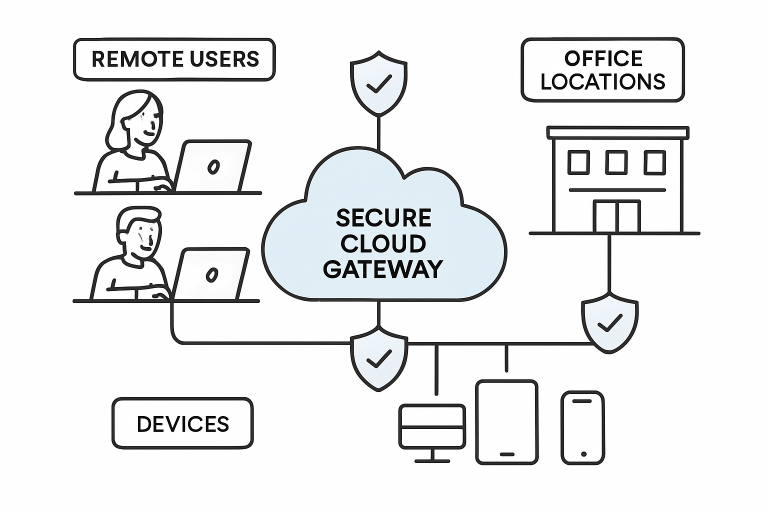
Cloud-native SWGs provide the flexibility and scalability that digital-first businesses require. By decoupling security controls from physical appliances, these solutions enable unrestricted coverage across multiple locations, devices, and endpoints. Organizations achieve uniform protection whether employees are at headquarters, branch offices, or working remotely.
Beyond security, cloud-native SWGs also streamline updates, patching, and redundancy, reducing ongoing operational complexity. The move to the cloud aligns IT resources with changing work patterns and fosters business resilience in the face of cyber attacks, outages, or disruptions.
Challenges and Considerations
While the adoption of advanced SWGs unlocks significant benefits, organizations must navigate several key challenges. These include ensuring seamless integration with legacy tools, minimizing latency to sustain performance, and establishing clear policies for data privacy and regulatory compliance. Continuous monitoring, regular updates, and user education remain essential to maximizing SWG effectiveness and staying ahead of rapidly evolving cyber threats.
To further develop a resilient cybersecurity posture, IT leaders should invest in cross-team collaboration and embrace a lifecycle approach to digital risk management, incorporating SWGs as a foundational element.
Conclusion
As digital transformation expands across every sector, Secure Web Gateways will remain indispensable for defending the modern enterprise. By tying SWGs to Zero Trust and SASE models, leveraging next-generation AI, and embracing cloud-native architecture, organizations can establish a future-proof cyber defense that supports secure, scalable, and productive operations.
