

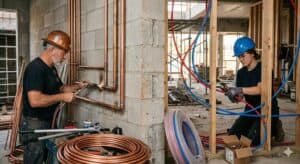
The debate between copper and PEX piping has been running through the construction industry for years.
On the surface, the comparison appears straightforward. Copper is durable, proven, and familiar. PEX is flexible, lightweight, and generally cheaper to install.
Yet conversations around piping materials often focus heavily on upfront costs while overlooking what happens after a project is handed over.
That creates a common blind spot.
Most piping decisions are made during construction. Most piping consequences emerge years later.
For builders, developers, facility managers, plumbers, and asset owners, the more useful question is not which material costs less today. It is which material creates fewer operational, maintenance, and replacement challenges over the life of the building.
The answer is rarely as simple as advocates from either side would suggest.
Why Initial Installation Costs Favour PEX
There is little debate regarding installation economics.
PEX systems are typically faster and easier to install than copper.
The material itself is generally less expensive, weighs significantly less, and requires fewer fittings in many applications. Installers can often route PEX through wall cavities and roof spaces with greater flexibility, reducing labour hours during construction.
For developers operating under tight budgets, these advantages are difficult to ignore.
Labour costs continue to rise across Australia, and workforce shortages remain a challenge throughout the construction sector. Any product that reduces installation time naturally attracts attention.
From a project management perspective, PEX can also simplify scheduling.
Faster installation means plumbing rough-ins can often be completed more quickly, reducing pressure on subsequent trades.
This explains why PEX adoption has increased across residential construction over the past two decades.
But installation efficiency tells only part of the story.
A building’s plumbing system may remain in service for decades. The material decision often outlives the project team that originally selected it.
The Problem With Evaluating Materials Through Construction Budgets Alone
One of the most common tensions in construction is the disconnect between project delivery and long-term ownership.
Developers typically focus on capital expenditure.
Building owners focus on operational expenditure.
The two objectives are related but not always aligned.
A product that reduces construction costs may introduce additional maintenance complexity years later. Conversely, a more expensive product may reduce long-term operational risk.
This creates an important contradiction.
The people choosing materials are often not the people responsible for maintaining them.
Asset managers understand this dynamic well.
Many maintenance challenges originate from decisions made long before operational teams become involved.
As one facilities manager once remarked during a property conference discussion, “The construction team buys the system. Operations inherits it.”
That observation resonates across almost every major building category.
Copper’s Advantage Is Often Predictability
Copper’s reputation has been built over generations.
It is not a new technology. It is not an emerging material. Its performance characteristics are widely understood by engineers, plumbers, insurers, and maintenance teams.
This predictability carries significant value.
When evaluating long-term building assets, uncertainty frequently becomes a larger risk than cost.
Copper’s durability under a wide range of environmental conditions has made it a preferred choice in commercial buildings, healthcare facilities, industrial sites, and infrastructure projects where system failures can be expensive.
Many experienced contractors trust copper because its strengths and weaknesses are well documented.
The material’s long history creates a level of confidence that newer alternatives are still working to establish.
One of the less discussed realities of construction is that stakeholders often place a premium on predictability rather than perfection.
Reliable performance over decades is often more valuable than theoretical efficiency gains that have yet to be fully proven under diverse operating conditions.
Maintenance Costs Are Often Driven by Accessibility
When comparing copper and PEX, discussions frequently focus on the pipe itself.
In practice, maintenance costs are often influenced by something else entirely.
Access.
A minor plumbing issue behind a tiled wall, inside a hospital ceiling space, or beneath a commercial fit-out can become expensive regardless of the material involved.
This changes how many asset owners evaluate piping systems.
The question becomes less about whether a component might eventually fail and more about the consequences if it does.
In high-accessibility environments, repairs may be relatively straightforward.
In complex commercial environments, remediation costs can quickly exceed the value of the original component.
This is why lifecycle thinking is becoming increasingly important across construction and facilities management.
According to research from Deloitte and McKinsey examining infrastructure and asset management practices globally, organisations are increasingly shifting toward whole-of-life cost analysis rather than focusing solely on capital expenditure.
The plumbing industry is experiencing a similar evolution.
Different Building Types Create Different Outcomes
There is no universal answer to the copper-versus-PEX question because building types introduce very different operational requirements.
A detached residential home operates under different conditions than a hospital.
A warehouse has different maintenance priorities than a university campus.
A retirement village presents different risk considerations than a shopping centre.
Material performance cannot be separated from context.
Copper may offer advantages in environments where longevity, fire resistance, or system familiarity are particularly important.
PEX may offer compelling benefits where installation speed, design flexibility, and budget efficiency are major priorities.
Experienced project teams understand this distinction.
They rarely ask which material is universally better.
They ask which material is better for this specific project.
That shift in thinking often produces better outcomes.
Supply Chain Reliability Has Become Part of the Equation
Material selection no longer revolves solely around engineering specifications.
Supply chain reliability increasingly influences purchasing decisions.
Recent disruptions across global manufacturing and logistics networks reminded many organisations that availability can be as important as performance.
Builders and contractors frequently assess not only the product but also the ecosystem supporting it.
Can replacement materials be sourced quickly?
Is technical support readily available?
Can additional stock be secured if project requirements change?
The strongest copper suppliers increasingly differentiate themselves through consistency, inventory visibility, technical support, and supply chain resilience rather than simply competing on price.
For project teams managing tight schedules, dependable supply often reduces risk more effectively than marginal savings on material costs.
As many procurement professionals have learned, the cheapest material can become the most expensive option if it causes delays.
The Psychology Behind Material Decisions
Material selection is rarely driven by data alone.
Human behaviour plays a significant role.
Some stakeholders naturally gravitate toward proven systems because familiarity reduces perceived risk.
Others favour newer solutions because innovation suggests efficiency gains.
Both perspectives contain merit.
The challenge is that construction decisions frequently occur under uncertainty.
Teams rarely possess perfect information about future maintenance requirements, environmental conditions, ownership changes, or operational demands.
As a result, material decisions often reflect organisational risk tolerance as much as technical analysis.
This explains why debates around copper and PEX remain active despite decades of discussion.
The conversation is not only about materials.
It is also about how organisations think about risk.
The Most Important Cost Is Often the One Missing From the Spreadsheet
The most sophisticated building owners increasingly evaluate materials through a broader lens.
They consider installation costs.
They consider maintenance costs.
They consider replacement costs.
But they also consider disruption costs.
Downtime.
Tenant complaints.
Business interruptions.
Emergency repairs.
Operational complexity.
These costs rarely appear in procurement spreadsheets, yet they often have the greatest impact over a building’s lifespan.
This leads to a useful observation:
“Materials are purchased once. Their consequences are managed for decades.”
That idea applies equally to copper, PEX, and virtually every major construction decision.
A Long-Term Perspective Produces Better Decisions
The debate between copper and PEX is unlikely to disappear anytime soon.
Both materials offer legitimate advantages. Both continue to play important roles across Australian construction.
The mistake is assuming the comparison begins and ends with installation cost.
In reality, the most effective evaluations consider maintenance requirements, operational risk, building type, accessibility, supply chain resilience, and asset lifespan.
When viewed through that broader perspective, material selection becomes less about winning a technical argument and more about managing long-term outcomes.
For builders, developers, facility managers, and asset owners, that distinction matters.
Because years after construction is complete, occupants rarely remember what material was installed.
They remember whether the building continued to perform as expected.
And that is ultimately the standard by which both piping systems and copper suppliers are judged.