

Key Takeaways:
- Organizational structure significantly influences a company’s ability to adapt and respond to market changes.
- Transitioning from hierarchical models to network-based structures can enhance agility and innovation.
- Real-world examples demonstrate the benefits of adopting agile organizational frameworks.
The Link Between Structure and Agility
Organizational structure forms the backbone of every company, explicitly assigning responsibilities and shaping the pathways through which information and decisions flow. A business’s structure determines whether innovation is stifled or supported and whether teams can respond rapidly to emerging challenges. Rigid, command-and-control models often lead to slower reactions, making it difficult to capitalize on new opportunities. In contrast, nimble, adaptive approaches encourage swift decision-making and experimentation. Companies increasingly seek expert guidance from partners like https://www.navalent.com/organization-design-consulting/ to redesign their organizational structure for agility and resilience.
The ever-accelerating pace of change in today’s marketplace means organizations can no longer rely on bureaucracy to navigate uncertainty. Instead, businesses that leverage adaptable structures are best equipped to thrive. Digital transformation, remote work, and rapidly shifting customer expectations all underscore the importance of structuring for agility.
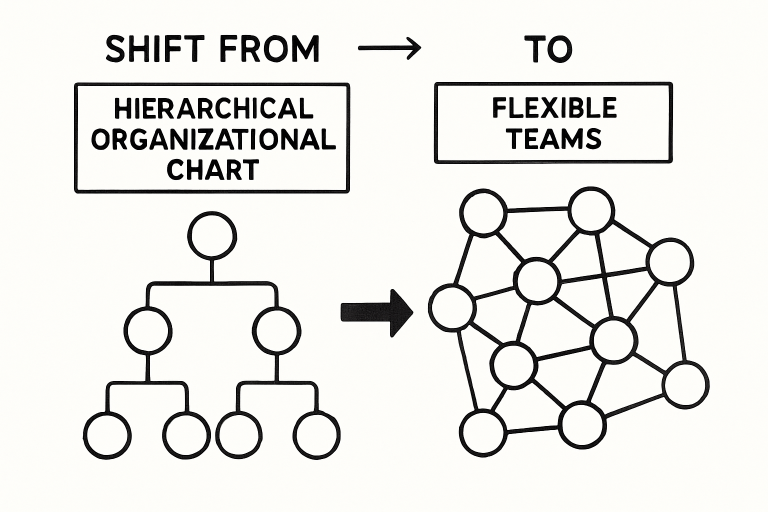
Under a traditional structure, communication and approvals must flow up and down established chains of command. This approach tends to bottleneck ideas and reactions, reducing a company’s capacity to seize short-lived advantages. Companies that recognize these limitations have begun reorganizing into interconnected networks with flexible structures in which information flows laterally and teams self-organize around challenges or opportunities as they emerge.
Organizations that aim to become truly agile must look beyond cosmetic changes and commit to deep structural transformation. Leaner, flatter models not only encourage rapid adaptation but also foster empowerment, creativity, and resilience across all levels of an organization.
Traditional Hierarchies vs. Agile Networks
Traditional organizational hierarchies, characterized by clear lines of authority and departmental silos, have long dominated the business landscape. These models provide clarity and stability but often inhibit collaboration and responsiveness. In practice, departments operate in near isolation, with little incentive or opportunity to share knowledge and resources. This model is particularly ill-suited to volatile or innovation-driven industries, where rapid integration of cross-functional expertise is critical.
Agile network-based structures, by contrast, focus on collaboration, openness, and adaptability. Rather than operating in silos, employees work across self-organized teams or “networks of competence.” Members are empowered to take initiative and drive progress, trusting their collective expertise to inform decisions. By removing rigid barriers and flattening the hierarchy, businesses find it easier to reallocate resources, address customer needs, and accelerate product development cycles. The balance between structure and flexibility is a hallmark of the world’s most forward-thinking organizations, as highlighted in coverage by the Harvard Business Review.
Case Studies of Agile Transformations
Many companies have demonstrated measurable gains from adopting agile structures:
- ING Bank: The multinational bank took inspiration from technology leaders and reorganized its workforce into small, cross-functional squads. These autonomous units gained the authority to make key decisions, helping the bank respond in real time to changes in customer demand and regulatory requirements. The result was not only faster product launches but also higher employee satisfaction.
- Zappos: In a bold experiment with Holacracy, the online retailer moved away from traditional job titles, creating a self-management system that eliminated much of the bureaucratic red tape. This radical step increased accountability, enhanced job fulfillment, and boosted innovation across every team.
- Nordstrom: The retailer has long been known for its focus on customer experience, but it took things further by deploying agile practices throughout its organization. By assembling cross-functional teams dedicated to specific aspects of the customer journey, Nordstrom became even more responsive to shopper feedback and emerging retail trends.
Each of these cases proves that carefully designed organizational change, when embraced at all levels, can generate lasting business agility and impact.
Strategies for Enhancing Organizational Agility
Businesses committed to becoming more agile can take tangible steps to redesign their structure:
- Develop an Agile Backbone: This foundation is built on a shared vision and an enterprise-wide commitment to flexibility. Structural agility must be championed by leadership and reflected in every system and policy.
- Instill Agile Thinking in Leadership and Teams: Leaders and team members should be trained not only in agile methodologies but also in the principles that support ongoing adaptation such as transparency, learning from failure, and iterative improvement.
- Focus on Value Creation: All agility efforts must be closely tied to organizational goals and prioritize high-impact initiatives. This clarity ensures that agility serves business outcomes rather than becoming an end in itself.
- Implement Agile Budgeting: Flexible financial planning and resource allocation allow teams to seize opportunities quickly, adapt to shifting priorities, and reduce wasted investment in outdated projects.
Overcoming Challenges in Agile Transformation
The path to agility is not without obstacles. Employee resistance is common, especially when teams are accustomed to the predictability of hierarchy. Organizational transformation can also incur substantial upfront costs. To overcome these challenges, companies must invest in clear communication and transparent processes. A robust change management strategy, supported by ongoing leadership commitment, is critical to overcoming inertia and sustaining change. Insights from McKinsey & Company highlight the importance of addressing cultural barriers alongside structural ones.
The Role of Leadership in Agile Organizations
No agile transformation succeeds without active leadership. Modern leaders must articulate a vision of agility that excites and motivates staff at all levels. More than just granting autonomy, effective leaders model agile values empowering teams, celebrating iterative progress, and continuously seeking feedback. By fostering a growth-oriented culture and leading by example, they encourage resilience and collaborative problem-solving, creating an environment where business agility is sustainable.
Conclusion
An organization’s design determines how quickly and effectively it responds to change. Companies that overhaul rigid hierarchies in favor of flexible, network-based structures position themselves for lasting competitive advantage. When supported by agile leadership and a culture of constant improvement, these structural changes unlock new levels of innovation, customer focus, and resilience, equipping organizations to thrive in a fast-paced world.
