

Key Takeaways
- Understand the essentials of self-directed investing and the benefits of controlling your own portfolio.
- Set clear, measurable financial goals to guide your investment decisions.
- Assess your risk tolerance before selecting your investment mix.
- Explore different investment vehicles and understand their associated risks and potential rewards.
- Diversify across asset classes to achieve a balanced risk profile.
- Leverage digital tools and research resources for smarter portfolio management.
- Commit to regular portfolio reviews and rebalancing to stay on track.
- Continuously improve your knowledge to adapt your strategy in changing markets.
Table of Contents
- Understanding Self-Directed Investing
- Setting Financial Goals
- Assessing Risk Tolerance
- Choosing Investment Vehicles
- Diversifying Your Portfolio
- Utilizing Investment Tools and Resources
- Regularly Reviewing and Rebalancing
- Staying Informed and Educated
Taking control of your investments through a self-directed approach gives you the freedom to create a financial future that reflects your values and goals. By learning to build and manage your own portfolio, you can make informed decisions, adapt to changing markets, and potentially lower your costs compared to traditional financial advice. To get started, familiarize yourself with self-directed investing platforms that offer the tools and resources to open, manage, and grow your investment accounts independently.
Many investors find self-direction appealing due to flexibility, the autonomy it provides, and the opportunity to learn more about markets firsthand. However, becoming your own portfolio manager is not without its challenges. It requires regular attention, a willingness to learn, and a clear understanding of your long-term objectives. With the correct approach, discipline, and a willingness to stay informed, anyone can start investing on their own and build a foundation for achieving key life goals.
It’s important to remember that the learning curve in self-directed investing can be steep at first. With the right strategy and ongoing education, you can develop the confidence and skills needed to navigate the ups and downs of financial markets.
Beginner investors should also be aware of the importance of using reliable educational resources, including established news outlets and financial publications. These sources can provide in-depth analysis and up-to-date information to inform your portfolio construction choices.
Understanding Self-Directed Investing
Self-directed investing, also known as do-it-yourself (DIY) investing, puts individual investors in the driver’s seat of their financial journey. Unlike relying solely on financial advisors, self-directed investing empowers you to research, buy, and sell a wide array of assets—including stocks, bonds, exchange-traded funds (ETFs), and more on your own. This approach is attractive to those who want more control, potentially lower fees, and the ability to tailor a portfolio that precisely fits their goals. The core requirement is a willingness to learn the fundamentals of investing and take personal responsibility for outcomes.
Setting Financial Goals
Every successful investment portfolio starts with a clear set of financial objectives. Ask yourself: Why am I investing? Common reasons might include saving for retirement, purchasing a home, funding a child’s education, or building long-term wealth. Clearly defined goals will inform every decision you make, from asset allocation to risk management. Write these goals down, specifying target amounts and time horizons, and use them to guide your investment roadmap. The better you articulate your goals, the more focused and disciplined your investment strategy will be.
Assessing Risk Tolerance
Assessing how much uncertainty you’re comfortable with is essential before making any investment choices. Risk tolerance is unique to every individual and is influenced by your time horizon, financial situation, and personality. Those with longer time horizons, such as young professionals investing for retirement, might choose a higher stock allocation, which can provide higher returns but also come with greater volatility. Investors nearing a financial milestone may prefer the relative stability of bonds or cash equivalents.
Choosing Investment Vehicles
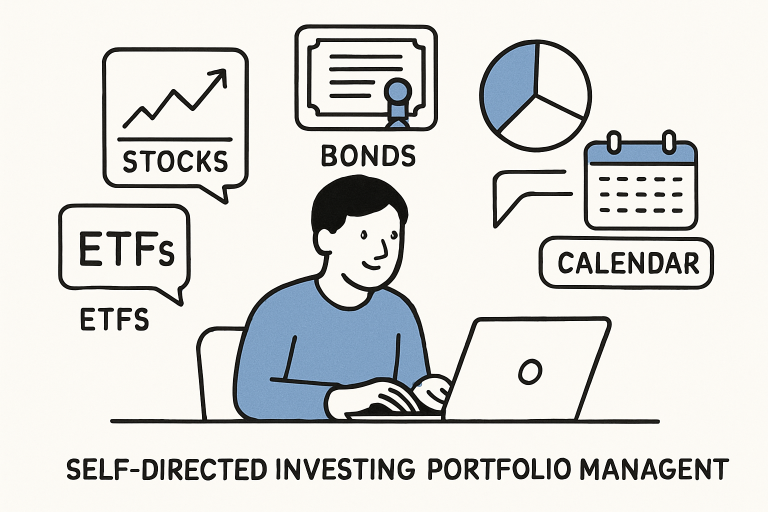
The core of your portfolio will be the types of assets you choose to include. Popular investment vehicles for self-directed investors include stocks, which represent ownership in companies; bonds, which are loans to corporations or governments; mutual funds and ETFs, which bundle many securities into a single investment. Each has its own risk profile: stocks are typically more volatile, while bonds generally offer more predictable returns. ETFs, for instance, can be an excellent fit for self-directed investors who want diversification and cost efficiency. The key is balancing your mix to achieve both growth and stability in line with your risk profile and goals.
Diversifying Your Portfolio
Diversification means spreading your investments across different asset classes, industry sectors, and geographies to manage risk. By not putting all your eggs in one basket, you can help cushion your portfolio against adverse events that could affect any single investment or sector. Experts recommend holding a blend of domestic and international equities, a mix of corporate and government bonds, and, where appropriate, alternative investments like REITs or commodities. This approach helps ensure your long-term plans are less affected by the ups and downs of various markets.
Utilizing Investment Tools and Resources
Modern brokerage accounts provide a host of digital resources to help self-directed investors succeed. These include real-time data dashboards, risk assessment tools, portfolio tracking, and educational content. Learning to use these features effectively is crucial for making timely, data-driven decisions. Additionally, respected financial news and data services, such as CNBC Investing, can expand your market awareness and help you stay up to date on macroeconomic shifts affecting your investments.
Regularly Reviewing and Rebalancing
Reviewing your portfolio is not a one-time event; it’s an ongoing process. Over time, market performance will inevitably cause your portfolio’s allocation to stray from your original plan. By scheduling periodic reviews, semiannually or annually, you can identify the need to rebalance. This involves selling outperforming assets and adding to underperformers to realign your portfolio with your intended risk level and targets. Adopting a regular rebalancing habit can help lock in gains and keep your investment journey on a steady course.
Staying Informed and Educated
The investing landscape is constantly evolving. Staying informed ensures your portfolio remains relevant and resilient. Subscribe to reputable newsletters, follow financial news, and participate in webinars or online courses to continually broaden your knowledge. Adapting to changes—such as shifts in interest rates, tax law updates, or new investment products, can turn challenges into opportunities and keep your self-directed investment strategy effective for years to come.
By following these practical steps and leveraging high-quality resources, you can confidently build a self-directed investment portfolio that aligns with your financial aspirations, adapts to your risk tolerance, and grows steadily over time.